

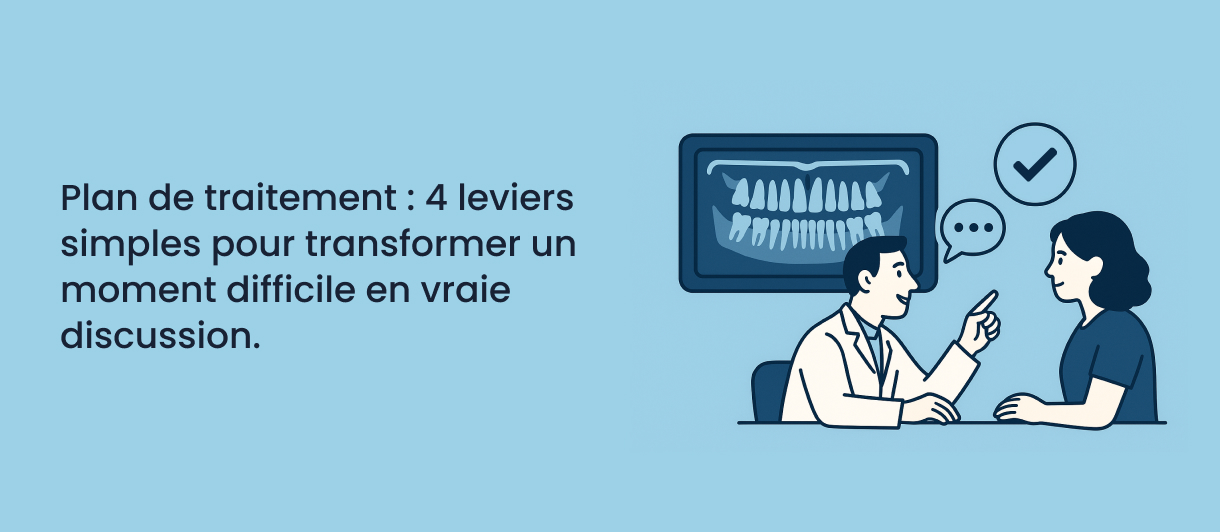
Presenting a treatment plan is a crucial moment in dental care. It directly influences the patient's decision to accept or reject the proposed treatment, impacts the trust established with the practitioner, and often determines the future of the therapeutic relationship. The figures speak for themselves: 65% of patients reportedly refused the treatment plan proposed during their last dental consultation, often due to a lack of understanding or perception of the urgency. This situation can weaken the therapeutic relationship and limit access to necessary care.
On the one hand, the information provided during the presentation is sometimes too technical or abstract for the patient to fully understand. On the other hand, the treatment plan is often perceived as a complex set of procedures that cause apprehension or even rejection. Furthermore, even when the explanation is clear at the time, patients often forget the details once they leave the office, making the decision more difficult to make.
However, it is possible to overcome these obstacles without extending consultation times or disrupting the practice's routine. By structuring the presentation better and using visual and educational tools, dental surgeons can strengthen patient adherence to treatment plans. This article proposes four concrete and easily implementable levers to improve this strategic stage of the care pathway.
1. Make information visual and educational
Most patients don't know how to interpret a black-and-white dental X-ray without explicit visual cues. As Dr. Lionel Elbaz, CEO Allisone, explains: "We spend a lot of time explaining to our patients what an X-ray shows. They don't always understand, or when they do understand and come back two weeks later, they've forgotten." This difficulty in understanding is completely normal: dentists have studied for "six or seven years, and you can't expect a patient to understand what you're telling them in ten minutes." This gap between the practitioner's medical expertise and the patient's ability to assimilate information is a major obstacle to the acceptance of treatment plans.
To remedy this problem, innovative tools such as Allisone the intraoral camera offer effective solutions. The latter allows high-resolution images of the oral cavity to be captured, making it easier to explain pathologies to patients. It illustrates the condition of the patient's teeth, replacing an abstract explanation with a concrete visualization.
For her part, Allisone patient understanding through educational visualization of dental X-rays, enabling them to become more engaged in their care journey and actively participate in treatment planning.
The impact is significant and quantifiable: patients better understand what they have, why they are being offered a particular treatment, and thus become actively involved in their oral health. The 24% increase in adherence rates amongAllisone usersAllisone the effectiveness of this approach. Educational research (The Cambridge Handbook of Multimedia Learning, Richard E. Meyer) shows that it is not the image itself that makes the difference, but the way it is used. A visual that clearly supports the message reinforces memorization and information retention.
By integrating these solutions into your daily practice, you can offer a clearer and more engaging approach, promoting informed patient decision-making. By making medical information accessible, these devices contribute to greater acceptance of treatment plans.
2. Present the plan in several clear steps
A comprehensive and compact treatment plan can seem daunting to patients, generating immediate psychological resistance. Faced with a series of technical procedures, multiple deadlines, and significant costs, patients can quickly feel overwhelmed and give up on the recommended treatment.
To better support patients during this stage, a sequential presentation of the treatment plan is significantly more effective. The ideal treatment plan often spans several phases, starting with immediate interventions and disease control, and extending to long-term care strategies. This structure allows patients to visualize a progressive journey, with distinct and logical steps, rather than an intimidating monolithic block of care.
An effective dental treatment plan usually begins with an initial assessment of the patient, during which the dentist reviews their medical history and performs clinical examinations. Next, each phase is clearly defined with short-, medium-, and long-term interventions. This step-by-step presentation helps to give meaning to the proposed care, while limiting the paralysis effect that can result from an overly ambitious project.
Platforms such as Allisone this step-by-step presentation by integrating a sequential display of the steps directly into the software, making each phase easier for the patient to understand.
3. Create continuity after the consultation
In dental practice, it is common for patients to retain only part of the information they receive during a consultation. Even when the explanation is clear and well understood at the time, patients can quickly forget 50% of the information within 30 minutes of leaving the office. This is a significant barrier to treatment adherence: patients who do not clearly remember the benefits or necessity of treatment are more likely to postpone or abandon their decision.
Communication tools play a key role in addressing this challenge. They can take the form of an explanatory PDF, an annotated view of the X-ray, educational sheets that visually explain the treatment, and a simplified, step-by-step view of the treatment plan. For example, sending a post-consultation report by email, such as those generated by Allisone particularly effective.
This post-consultation follow-up gives patients valuable time to reflect, allowing them to absorb the information, discuss it with their loved ones if necessary, and make a decision outside the sometimes stressful environment of the dentist's office. The visual aids provided serve as an objective and transparent reference, refreshing the patient's memory of the explanations they have received and reinforcing their understanding of the treatment options. This has a particular impact on cognitive biases, strengthening feelings of trust and credibility.
4. Train the team to speak the same language
Consistency in communication within the dental team is essential for promoting acceptance of treatment plans. When every member of the practice speaks with one voice and conveys the same information, this reassures patients and strengthens their confidence in the care being offered.
All team members, whether dentists, assistants, or administrative staff, must be informed of ongoing treatments and the explanations provided to patients. Everyone must be able to answer questions clearly and accurately. Lack of coordination could compromise patient compliance with treatment. Contradictory or inaccurate information can confuse the patient and undermine the credibility of the practice. To avoid such situations, collective preparation and the sharing of key information with the entire team are essential, for example by establishing internal communication protocols to ensure consistency in the messages conveyed.
Tools such as Allisone to this consistency by structuring information in a standardized way and making it easy to share within the team. Thanks to shared visuals and annotated explanations, each professional has a reliable tool for communicating with patients. This approach ensures that, regardless of who is communicating with the patient, the message remains consistent and understandable, which strengthens the relationship of trust with the patient. By relying on these solutions, dental practices improve their communication and encourage patient adherence to treatment plans.
Conclusion
Strengthening acceptance of treatment plans in dental practices requires transforming the presentation approach by relying on concrete and proven levers. When information is made more visual and educational, explanations are structured, follow-up is put in place, and the team speaks with one voice, patient buy-in naturally increases. Solutions such as Allisone to create this climate of trust and transparency with patients.
Integrating these practices into the daily routine of the dental practice allows for a structured, patient-centered approach and supports the evolution of the practice's organization. By leveraging modern tools and an educational approach, practitioners can transform what is sometimes a daunting step into a moment of constructive and engaging dialogue. This translates into greater adherence to the proposed treatment and a stronger, more lasting therapeutic relationship.
Related articles
All the latest news on the future of dentistry

Artificial intelligence at the heart of dental care: testimony from Dr. Paola
Making treatment plans more acceptable: 4 strategies that really work


