Digital and Health
4

Allisone obtains CE marking as a medical device

Published on
February 24, 2026
Receive all the latest news

All the latest news on the future of dentistry, delivered straight to your inbox.

Thank you! Your submission has been received!
Oops! Something went wrong while submitting the form.

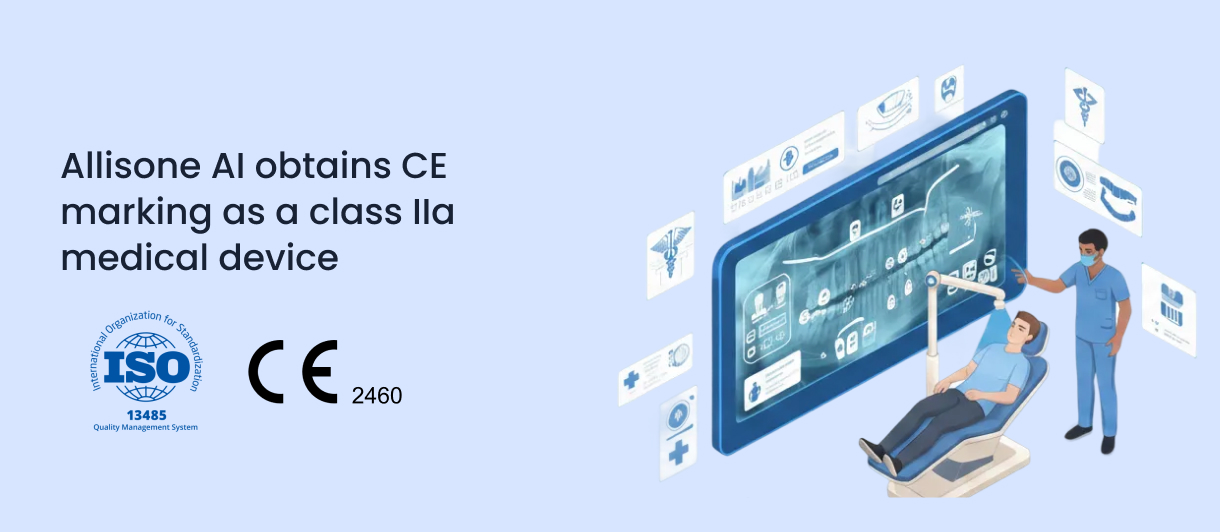
We recently took a decisive step forward in our commitment to quality and safety by obtaining CE marking as a Class IIa medical device. This certificate indicates that our AI-integrated software is safe for patients and users and performs well compared to the state of the art on the market.

The CE marking is much more than just a label. It guarantees that devices, whether physical or digital, meet rigorous requirements in terms of safety, reliability, and traceability. This distinction reflects our commitment at Allisone providing dental surgeons with a diagnostic aid that improves their practice while complying with current regulations.

In this article, we will explore the specific characteristics of Class IIa medical devices, the rigorous certification process for software medical devices, and the practical implications of this recognition for healthcare professionals.

Class IIa medical device (MD)

What is a medical device?

Medical devices include tools and software designed to support healthcare professionals in their daily work. They can be used to diagnose, monitor, treat, or alleviate a disease. They range from surgical instruments to radiology equipment and digital innovations such as medical image analysis software.

A platform such as Allisone , for example, uses artificial intelligence to analyze dental X-rays. It does not replace the dentist's clinical judgment, but assists them by providing a second opinion and detecting pathologies that are difficult to spot. This makes it particularly relevant in clinical practice.

Excerpt from European Regulation 2017/745:

"Medical device": any instrument, apparatus, equipment, software, implant, reagent, material, or other article intended by the manufacturer to be used, alone or in combination, in humans for one or more of the following specific medical purposes:
- diagnosis, prevention, monitoring, prediction, prognosis, treatment, or alleviation of disease,

- diagnosis, monitoring, treatment, alleviation of, or compensation for, an injury or handicap,

- investigation, replacement, or modification of the anatomy or of a physiological or pathological process or state,

- communication of information by means of in vitro examination of samples from the human body, including organ, blood, and tissue donations, and whose main intended action in or on the human body is not achieved by pharmacological or immunological means or by metabolism, but whose function may be assisted by such means.

The following products are also considered to be medical devices:
1. devices intended to control or assist conception,

2. products specifically intended for cleaning, disinfecting, or sterilizing the devices referred to in Article 1(4) and those referred to in the first paragraph of this point.

Class IIa: a classification for greater safety

La classe IIa regroupe les dispositifs qui présentent un niveau de risque modéré pouvant être utilisés par des patients ou par un professionnel de santé. Cela inclut des outils comme les logiciels de diagnostic assisté. Cette classification impose des exigences claires :

  • Safety: the device must be designed to avoid any unnecessary risk to the patient.
  • Performance: we are bringing to market a medical device that incorporates algorithms whose performance has been compared and validated against those currently available on the market.
  • Quality: every step, from design to use, must be rigorously controlled and documented.

For a dentist, this means that the tool has been tested and validated according to demanding European standards, guaranteeing its reliability in clinical practice.

Why is this certification important?

The CE marking provides essential assurance: the device has been evaluated by independent experts and complies with the safety and quality standards in force in Europe. In other words, it is a guarantee of trust, both for professionals and their patients.

Allisone , a Class IIa medical device, helps dentists interpret X-rays and make informed decisions. It also facilitates communication with patients and builds trust by making diagnoses more visually accessible and understandable.

Certification of standalone software medical devices

What is a software medical device?

A software medical device is a technological tool designed to meet specific healthcare needs. Unlike traditional medical devices, software medical devices rely on algorithms or mobile applications to collect, analyze, and interpret health data.

These devices go beyond task automation by providing assistance based on objective and reliable data. However, to ensure their safety and performance, they must meet specific standards defined by European regulations.

How do you obtain CE certification for a medical device software?

CE certification is essential for a medical device to be marketed in Europe. It ensures that the device meets the safety, reliability, and quality standards defined by European Regulation 2017/745.

Here are the main steps to obtain this certification:

  1. Risk and benefit analysis: the manufacturer identifies the potential risks associated with the use of the device and demonstrates that they are reduced as much as possible and controlled.
  2. Clinical evaluation: scientific data is collected to prove the effectiveness and safety of the tool in a real-world setting. Clinical investigations are conducted to scientifically validate the clinical performance of the medical device.
  3. Audit by a notified body: an independent body reviews the technical documentation and the whole system, including manufacturing and post-market surveillance processes, as well as the rest of the quality system.
  4. Regulatory compliance: the manufacturer guarantees that its device complies with regulations, demonstrating its ability to maintain the same level of requirements throughout the medical device's life cycle.

Allisone this long and rigorous process, with each step validated to ensure optimal safety and performance for dentists and their patients.

What are the commitments associated with this certification?

Obtaining CE marking requires a strong commitment on the part of the manufacturer. They must:

  • Maintaining consistent quality: software updates and upgrades must continuously keep pace with regulatory and normative developments.
  • Ensure traceability: every change or development must be documented and justified.
  • Protecting user data: Digital medical devices process health data. Manufacturers must therefore comply with applicable regulations regarding the storage, processing, and protection of this data (GDPR).

For dentists, this means working with a tool that is constantly improving, but always complies with regulatory requirements.

The path to certification may seem complex, but it is essential to ensure that digital devices remain reliable and secure. Thanks to this process, dental surgeons can use tools such as Allisone with confidence, knowing that they meet the highest standards in the medical industry.

The limitations of certified software medical devices

A digital medical device does not replace the clinical judgment of the practitioner. Although it can analyze data and offer accurate interpretations, it remains a decision-making aid, a second medical opinion. The final responsibility for diagnosis and treatment always rests with the practitioner.

For example, Allisone can identify anomalies on a dental X-ray, but it is up to the dental surgeon to confirm these results based on the patient's clinical context. This complementary role underscores the importance of never relying exclusively on the tool, even if it is certified and effective.

A certified device is reliable, but it is not foolproof. Several factors can influence its operation:

  • Input data quality: the accuracy of the software depends on the quality of the X-rays or data it analyzes. A blurry or poorly framed image can limit its performance.
  • Terms of use: A digital medical device operates under specific conditions, which are outlined in the user manual. If these conditions are not met, the results may be less accurate or incorrect. The software may not be able to provide a result.
  • Advances in medical knowledge: certified devices are based on the data available at the time of their design. As medical knowledge evolves rapidly, the tool must be updated regularly to remain relevant.

To maximize the benefits of a DMN, it is essential that professionals know how to use it and interpret its results. Reading the user manual and having a clear understanding of the tool's limitations are essential. This ensures informed use, in compliance with ethical and regulatory standards.

Allisone has been designed to integrate into the daily practice of dental surgeons while respecting these limitations. Our software provides reliable and clear analyses, but always leaves the practitioner responsible for validating the diagnosis. With its intuitive interface and educational features, it also facilitates communication with patients, helping them to better understand their oral health.

Obtaining Class IIa medical device CE marking confirms thatAllisone meets the quality, safety, and reliability requirements set by European regulations and standards. This provides additional assurance for dental surgeons who wish to integrate digital tools into their practice while complying with regulatory requirements.

Allisone remains first and foremost a second viewer, a second opinion. It helps you better interpret X-rays and communicate clearly with your patients, but it relies on your expertise to transform this data into informed decisions. This complementarity between the digital tool and clinical judgment plays a key role in improving care.

With this certification, Allisone positions Allisone as a reliable and innovative partner in today's dentistry. Book a demo with us to discover how Allisone can modernize your practice.

Blog

Related articles

Lorem ipsum dolor sit amet, consectetur adipiscing elit.

Not yet anAllisone userAllisone

Request a demo

Allisone obtains CE marking as a medical device

Published on
February 24, 2026

We recently took a decisive step forward in our commitment to quality and safety by obtaining CE marking as a Class IIa medical device. This certificate indicates that our AI-integrated software is safe for patients and users and performs well compared to the state of the art on the market.

The CE marking is much more than just a label. It guarantees that devices, whether physical or digital, meet rigorous requirements in terms of safety, reliability, and traceability. This distinction reflects our commitment at Allisone providing dental surgeons with a diagnostic aid that improves their practice while complying with current regulations.

In this article, we will explore the specific characteristics of Class IIa medical devices, the rigorous certification process for software medical devices, and the practical implications of this recognition for healthcare professionals.

Class IIa medical device (MD)

What is a medical device?

Medical devices include tools and software designed to support healthcare professionals in their daily work. They can be used to diagnose, monitor, treat, or alleviate a disease. They range from surgical instruments to radiology equipment and digital innovations such as medical image analysis software.

A platform such as Allisone , for example, uses artificial intelligence to analyze dental X-rays. It does not replace the dentist's clinical judgment, but assists them by providing a second opinion and detecting pathologies that are difficult to spot. This makes it particularly relevant in clinical practice.

Excerpt from European Regulation 2017/745:

"Medical device": any instrument, apparatus, equipment, software, implant, reagent, material, or other article intended by the manufacturer to be used, alone or in combination, in humans for one or more of the following specific medical purposes:
- diagnosis, prevention, monitoring, prediction, prognosis, treatment, or alleviation of disease,

- diagnosis, monitoring, treatment, alleviation of, or compensation for, an injury or handicap,

- investigation, replacement, or modification of the anatomy or of a physiological or pathological process or state,

- communication of information by means of in vitro examination of samples from the human body, including organ, blood, and tissue donations, and whose main intended action in or on the human body is not achieved by pharmacological or immunological means or by metabolism, but whose function may be assisted by such means.

The following products are also considered to be medical devices:
1. devices intended to control or assist conception,

2. products specifically intended for cleaning, disinfecting, or sterilizing the devices referred to in Article 1(4) and those referred to in the first paragraph of this point.

Class IIa: a classification for greater safety

La classe IIa regroupe les dispositifs qui présentent un niveau de risque modéré pouvant être utilisés par des patients ou par un professionnel de santé. Cela inclut des outils comme les logiciels de diagnostic assisté. Cette classification impose des exigences claires :

  • Safety: the device must be designed to avoid any unnecessary risk to the patient.
  • Performance: we are bringing to market a medical device that incorporates algorithms whose performance has been compared and validated against those currently available on the market.
  • Quality: every step, from design to use, must be rigorously controlled and documented.

For a dentist, this means that the tool has been tested and validated according to demanding European standards, guaranteeing its reliability in clinical practice.

Why is this certification important?

The CE marking provides essential assurance: the device has been evaluated by independent experts and complies with the safety and quality standards in force in Europe. In other words, it is a guarantee of trust, both for professionals and their patients.

Allisone , a Class IIa medical device, helps dentists interpret X-rays and make informed decisions. It also facilitates communication with patients and builds trust by making diagnoses more visually accessible and understandable.

Certification of standalone software medical devices

What is a software medical device?

A software medical device is a technological tool designed to meet specific healthcare needs. Unlike traditional medical devices, software medical devices rely on algorithms or mobile applications to collect, analyze, and interpret health data.

These devices go beyond task automation by providing assistance based on objective and reliable data. However, to ensure their safety and performance, they must meet specific standards defined by European regulations.

How do you obtain CE certification for a medical device software?

CE certification is essential for a medical device to be marketed in Europe. It ensures that the device meets the safety, reliability, and quality standards defined by European Regulation 2017/745.

Here are the main steps to obtain this certification:

  1. Risk and benefit analysis: the manufacturer identifies the potential risks associated with the use of the device and demonstrates that they are reduced as much as possible and controlled.
  2. Clinical evaluation: scientific data is collected to prove the effectiveness and safety of the tool in a real-world setting. Clinical investigations are conducted to scientifically validate the clinical performance of the medical device.
  3. Audit by a notified body: an independent body reviews the technical documentation and the whole system, including manufacturing and post-market surveillance processes, as well as the rest of the quality system.
  4. Regulatory compliance: the manufacturer guarantees that its device complies with regulations, demonstrating its ability to maintain the same level of requirements throughout the medical device's life cycle.

Allisone this long and rigorous process, with each step validated to ensure optimal safety and performance for dentists and their patients.

What are the commitments associated with this certification?

Obtaining CE marking requires a strong commitment on the part of the manufacturer. They must:

  • Maintaining consistent quality: software updates and upgrades must continuously keep pace with regulatory and normative developments.
  • Ensure traceability: every change or development must be documented and justified.
  • Protecting user data: Digital medical devices process health data. Manufacturers must therefore comply with applicable regulations regarding the storage, processing, and protection of this data (GDPR).

For dentists, this means working with a tool that is constantly improving, but always complies with regulatory requirements.

The path to certification may seem complex, but it is essential to ensure that digital devices remain reliable and secure. Thanks to this process, dental surgeons can use tools such as Allisone with confidence, knowing that they meet the highest standards in the medical industry.

The limitations of certified software medical devices

A digital medical device does not replace the clinical judgment of the practitioner. Although it can analyze data and offer accurate interpretations, it remains a decision-making aid, a second medical opinion. The final responsibility for diagnosis and treatment always rests with the practitioner.

For example, Allisone can identify anomalies on a dental X-ray, but it is up to the dental surgeon to confirm these results based on the patient's clinical context. This complementary role underscores the importance of never relying exclusively on the tool, even if it is certified and effective.

A certified device is reliable, but it is not foolproof. Several factors can influence its operation:

  • Input data quality: the accuracy of the software depends on the quality of the X-rays or data it analyzes. A blurry or poorly framed image can limit its performance.
  • Terms of use: A digital medical device operates under specific conditions, which are outlined in the user manual. If these conditions are not met, the results may be less accurate or incorrect. The software may not be able to provide a result.
  • Advances in medical knowledge: certified devices are based on the data available at the time of their design. As medical knowledge evolves rapidly, the tool must be updated regularly to remain relevant.

To maximize the benefits of a DMN, it is essential that professionals know how to use it and interpret its results. Reading the user manual and having a clear understanding of the tool's limitations are essential. This ensures informed use, in compliance with ethical and regulatory standards.

Allisone has been designed to integrate into the daily practice of dental surgeons while respecting these limitations. Our software provides reliable and clear analyses, but always leaves the practitioner responsible for validating the diagnosis. With its intuitive interface and educational features, it also facilitates communication with patients, helping them to better understand their oral health.

Obtaining Class IIa medical device CE marking confirms thatAllisone meets the quality, safety, and reliability requirements set by European regulations and standards. This provides additional assurance for dental surgeons who wish to integrate digital tools into their practice while complying with regulatory requirements.

Allisone remains first and foremost a second viewer, a second opinion. It helps you better interpret X-rays and communicate clearly with your patients, but it relies on your expertise to transform this data into informed decisions. This complementarity between the digital tool and clinical judgment plays a key role in improving care.

With this certification, Allisone positions Allisone as a reliable and innovative partner in today's dentistry. Book a demo with us to discover how Allisone can modernize your practice.

Get the latest updates from Allisone your inbox.

Get the latest updates from Allisone your inbox.

Our best news, once a month.
Guaranteed spam-free and full of good advice!

Allisoneas the data controller, processes the personal data collected in this form in order to process your request. For more information, please consult our privacy policy
Thank you! Your submission has been received!
Oops! Something went wrong while submitting the form.

Not yet anAllisone userAllisone

Find out what Allisone can do for you

DISCOVER ALLISONE